"Pay attention to the world." -- Susan Sontag
 

Iris domestica: From Summer to Fall (1 of 4)

From “Blackberry Lilies” in Garden Bulbs for the South by Scott Ogden:

“There is a speckled Asian irid that offers something of an analog to the American tigridias. The old botanical name for the plant is Pardanthus (‘leopard flower’). In the South these rich orange, purple-spotted blossoms have long been familiar as blackberry lilies, for the round, black seeds that persist clustered like blackberries after the fat pods open. Most garden literature refers to these perennials as Belamcanda chinensis, a Latinized version of their Asian name, balamtandam, and their home country, China. Recently, however, DNA-wielding botanists have assigned this distinctive plant the more pedestrian title Iris domestica.

“This flower was once common in gardens, but is now more often seen as an escape, growing on damp, acid soil. Like many other deserving plants, this easy-growing irid has yielded its place to more obvious blooms. Jefferson had it at Monticello, where he knew the colorful blossoms as Chinese ixia.

“The ephemeral flowers, appearing on slender stems above short fans of matte green foliage, continue over a long summer season. After the pretty flowers fade, the capsules enlarge to form the handsome ‘blackberries,’ which persist over winter and as cut decorations for autumn vases. The fleshy roots develop offsets that may be divided for increase, and the seeds, when sown, often flower the first season.

“In addition to the common purple and orange of the wild
Iris domestica, nurseries provide a pale yellow selection, ‘Hello Yellow,’ and several hybrids with the Mongolian I. dichotoma.… Usually sold as pardancandas or candy lilies, they come in a wide range of exotic, warm-colored pastels. All grow readily on damp ground and make showy, but short-lived perennials. They grow easily from seed and mix cheerfully in borders of white phlox, yellow daylilies, or blue mistflowers….”

From “A Poem About Icebergs and Planting” by Susan Ingersoll in The Backyards of Heaven: An Anthology of Contemporary Poetry:

let there be
blackberry lilies,
starry mountain bluets…

let the cycle of renewal
rumoured at another season
be complete

now the earth will turn again
toward the light

let the bee balm return, and the bee,
and the honeysuckle
and the sun

these seeds are shiny black
like shot, messages
sent underground to the future,
that august should see…

belamcanda chinensis

in the name of faith in
the name of magic


Hello!

This is the first of four posts with photos of Iris domestica — a plant with many fun common names like Leopard Lily, Leopard Flower, Blackberry Lily, Candy Lily, Freckle Face, Butterfly Lily, and Fire Lily — that I took at Oakland Cemetery during the summer and early fall. I first discovered roving packs of Iris domestica at Oakland in 2022 (see Leopard Flower Variations), returned to photograph them in 2023 (see Iris Domestica, the Leopard Flower or Blackberry Lily (1 of 3)), and again returned to photograph them in 2024 (see Iris Domestica Fireworks (1 of 2)).

Across those years, I experimented quite a bit with rendering their colors in different tones, varying white balance to demonstrate how that shifts orange and yellow between warmer and cooler shades, and isolating the flowers on black backgrounds to show off the structure of their petals, stems, and leaves. Each new batch of the plants gave me an opportunity to try new photographic treatments but also to learn more about them, as I uncovered fascinating stories about how they were introduced at Thomas Jefferson’s Monticello gardens in the early 1800s; how their scientific name changed from Belamcanda chinensis to Iris domestica just twenty years ago; that they were determined to be members of the Iris family and are not lilies at all; that there are cultivars whose appearance contradicts the common names Leopard Flower and Leopard Lily by having eliminated the dark spots that established the plant’s “leopard” nickname to begin with; and — from the Scott Ogden book excerpt above — that Iris domestica behaves as an escaped plant impervious to human intent to constrain its spatial growth as it ventures out beyond any borders. This last point is evident in how I’ve seen the plants make their way around Oakland, from a couple of defined clusters at the boundaries of several garden pathways that I encountered in 2022, to randomly appear in new locations from one year to the next.

One of its cultivars — Iris domestica ‘Hello Yellow’ — made its debut at Oakland just this year, appearing in this memorial scene as a crowded mass of flowers whose density increased as the summer went on:

I was out photographing daylilies on the morning I came across these, and almost passed them by because from a distance they looked like yellow daylilies, which I’d already photographed abundantly. Once I realized they were an Iris domestica variant — the flower shape reveals their identity — I spent plenty of my shoot time photographing these from various distances and angles to study their characteristics and observe more about how different they are from the plants that produce spotted orange flowers. Over this post and the next three, then, we’ll look at two sets of photos featuring plants with orange petals and leopard spots, and two sets of photos featuring Hello Yellow, while we explore their botanical similarities and differences in some detail.

June and July are peak bloom times for most Iris domestica variants, and in the past, I’ve shared their photos during the summer — but I held off this year to capture the plant’s full growth and reproductive cycle from buds and blooms, to seed capsule generation, then finally to the production of “blackberries” represented in the “Blackberry Lily” common name.

The first five photos below this paragraph show the orange-spotted variant during its blooming period (I took these photos toward the end of June), where even here you can see some fully opened flowers, some that have not yet opened, and a few whose flowers have twisted into the tight spirals that are one of Iris domestica’s distinctive features. This range of development states is common to many flowering plants and represents a timed blooming that occurs sequentially over several days to present multiple opportunities for visiting pollinators. The flower twisting that Iris domestica produces, though, is quite uncommon, and represents a transitional stage for this plant, where the flower is closed to pollinators because of its reduced visibility. The twisted flower — which is quite stiff to the touch — also serves as a protective mechanism for the seed packet that will grow to eventually push the desiccated flower off the stem.

By the middle of July, the same plants have entered the second stage of their lifecycle, where all of the flowers have been replaced by seed capsules. While not especially photogenic (three photos seemed like enough to show this stage), the capsules are botanically and biologically significant, as their blackberries are growing inside. Some of the capsules are quite large — up to an inch in length — and as fat as a thumb. The third photo emphasizes their size, but also shows a tiny “pin” at the top of each one, from where the twisted flower has completely dropped off. The green capsules continue to grow for several more weeks, through the end of summer and into early fall.

Fast forward to October (I took these photos just last week, on October 6), and now we can see what has happened since the seed capsules have dried up, split open, and gotten discarded: the berries of Blackberry Lily fame appear as clusters at the ends of many stems, somewhat protected by what remains of the capsule and the dried leaves where the flowers once extended from the stems ends. The berries will be picked up by flying seed dispersal agents like birds, or scattered by the wind, or brushed off the plants by humans or other animals passing by — to find their way into the ground and enable the plants to spread into their next seasonal cycle, taken root and germinating wherever environmental conditions are suitable.

Here in the Southeast, the appearance of Iris domestica berries is one of the first indicators that autumn has arrived, even before frosty temperatures kick in and other plants, trees, and shrubs start producing the colors of fall. And for those of us already thinking ahead to the upcoming winter holidays, the contrasting blue-black colors of the berries surrounded by yellow-gold leaves might trigger early thoughts of Christmas decorations, especially Christmas picks and sprays whose designs are often based on the shapes and colors of plants like Blackberry Lilies, and whose cuttings fill our mantles, windows, tables, and vases from November until the new year.

Thanks for reading and taking a look!


An Amaryllis Family Gathering (4 of 4)

From Garden Bulbs for the South by Scott Ogden:

“The most popular of the spring growers is Lycoris squamigera, an old garden selection known as the magic lily. One rarely finds a more beautiful flower possessed of such an undemanding disposition. It’s nearly ideal for gardens in the middle and upper South, and even into the cold climates of the Midwest. On both sandy acid soils and heavy alkaline clays, L. squamigera thrives.

“Sometime after the Fourth of July, rainfall triggers the thick scapes of surprise lilies to bolt upward from the ground. They rise swiftly, in four or five days expanding to crowns of succulent, lilac-pink buds. The clustered blossoms open to look like small amaryllises, shimmering with lavender highlights on their broad rounded petals.

“Like the triploid
Lycoris radiata, this strong-growing species enjoys an extra set of chromosomes, which fuel unusual vigor. Genetic evidence suggests that these were acquired through hybridization….

Lycoris squamigera reportedly came to America with a certain Dr. Hall of Bristol, Rhode Island, who grew the flowers in his garden in Shanghai, China, prior to the American Civil War. Several other spring-growing lycoris have made their way to North America, but none approach Lycoris squamigera in prominence or widespread adaptability….

Lycoris incarnata is occasionally offered as well; its rose blooms are accented by electric-blue petals…. [They] have gray-green spring foliage and produce flowers in late summer along with Lycoris squamigera….”

From “The Metaphysical Garden” in Collected Poems (1930-1973) by May Sarton:

It was late in September when you took me
To that amazing garden, hidden in the city,
Tranquil and complicated as an open hand,
There among green pleasances and descant of fountains,
Through walled paths and dappled loggias
Opening to distant trees,
We went conversing, smoking, often silent,
Our feet cool in sandals, nonchalant as the air.

It was at the end of September, warm for the season.
Nothing had fallen yet to bruise the grass.
Ripeness was all suspended,
The air aromatic and fresh over sun-drenched box.

Critical as Chinese philosophers,
We performed the garden by easy stages:
Should we move toward shade or toward sunlight,
The closed dark pool or the panoplied fountain?

Clearly each path had a metaphysical meaning,
Those rustic steps, that marble balustrade.
It was late in September when time,
Time that is not ours,
Hid itself away.


Hello!

This is the fourth of four posts with photos of Amaryllis family plants that I photographed during the summer. The previous posts are An Amaryllis Family Gathering (1 of 4), An Amaryllis Family Gathering (2 of 4), and An Amaryllis Family Gathering (3 of 4).

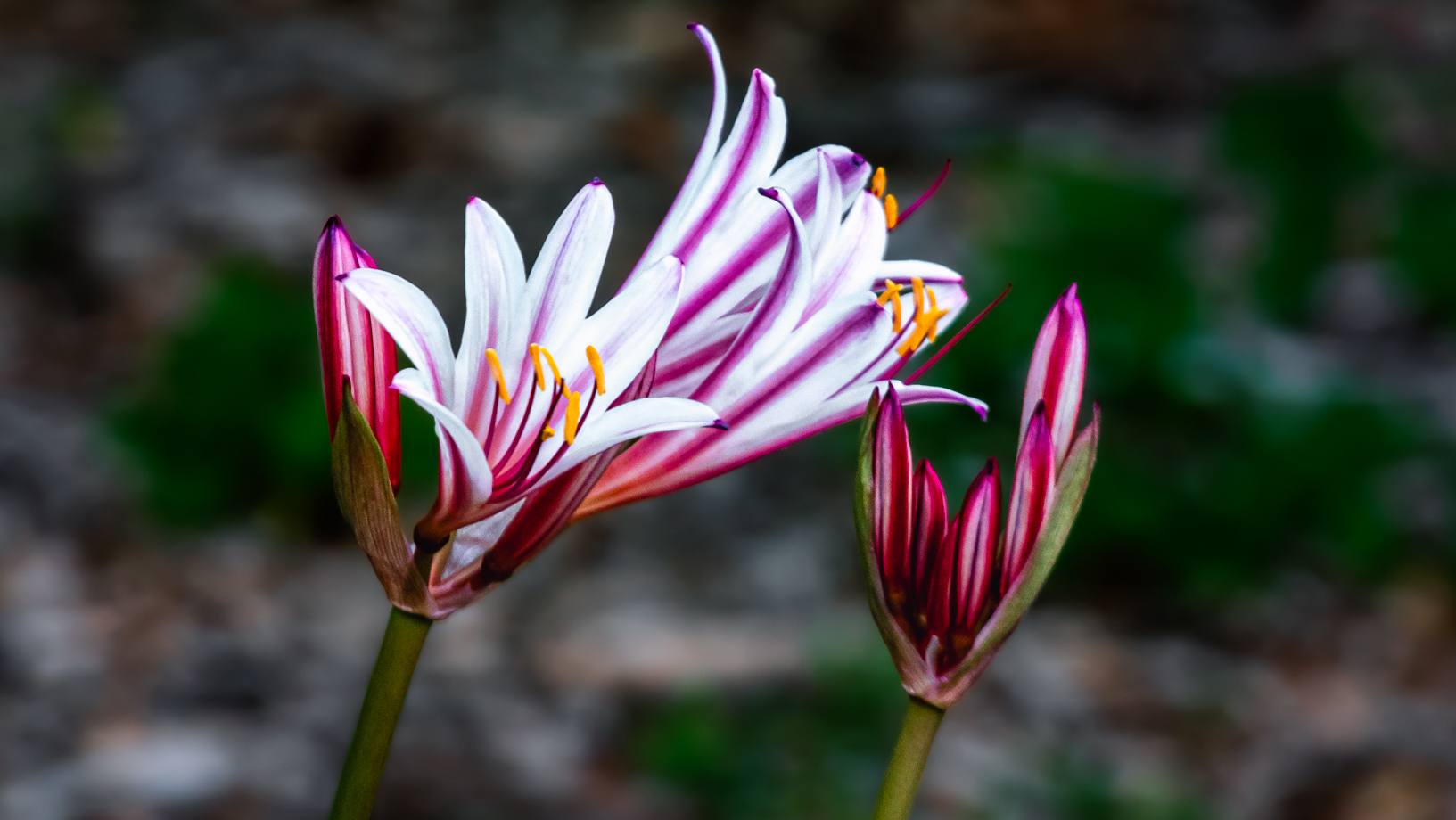
The series features photos of Amaryllis family members Crinum bulbispermum, Lycoris squamigera, andย Lycoris incarnata. The first two are well-known and common historical garden plants, while the last —ย Lycoris incarnata, or the Peppermint Spider Lily — is a bit more mysterious but nevertheless delightful to have encountered and photographed.

I’m posting this on the last day of September, so I was glad to find a poem — “The Metaphysical Garden” by May Sarton — that seems to capture the sense of exploring a historical garden on one of those days marking the transition from summer to fall. I excerpted just the opening four stanzas; but it’s much longer than that and you can read the whole poem here, if you’d like.

Thanks for taking a look! See you in October!


An Amaryllis Family Gathering (3 of 4)

From “Lycoris” in Sub-Tropical Bulbs and Plants by Wyndham Hayward:

“Lycoris are becoming fashionable and more popular with every succeeding season.

“For years
Lycoris Squamigera has been a lovely garden flower in the North, blooming before the leaves appear in late summer, and marked by an exotic beauty of violet-rose Amaryllis-like blooms in good-sized umbels.

“In the lower South,
Lycoris Radiata, which… is commonly known as the ‘Red Spider Lily,’ is a well-known plant in every dooryard through Georgia, Alabama and Mississippi. It does well in North Florida, but seems to like an alkaline soil, so usually has to be replaced in Peninsular Florida every few years.

“One of our fortunate achievements of the past year is the importation of a modest stock of the handsome
Lycoris aurea, long grown in old gardens around St. Augustine, where it is called the Golden Hurricane Lily and blooms in early Fall, during the Caribbean ‘tropical storm’ season. It is a rich golden yellow, with crinkled petals in a strangely enchanting and exotic umbel which opens practically all of its 5 to 10 flowers at the same time or in rapid succession. This is one of the choicest bulbs of all horticulture and was painted by Redoute, floral artist to the Empress Josephine, and it appears in his famous ‘Liliacees,’ of 1815 or so, although it really belongs to the Amaryllis family….

“We also offer three rarities,
Lycoris alba, a creamy white and pinkish novelty, not yet positively identified, L. squamigera var. purpurea, a lovely thing for the North and Lower South as well, being quite hardy, and Lycoris incarnata, as received from China.

“We are not sure what this last will turn out to be.”

From “Lycoris” in A Southern Garden: A Handbook for the Middle South by Elizabeth Lawrence:

“Hall’s amaryllis, Lycoris squamigera, is a hardy bulb from Japan. The naked scapes come up in summer, and the wide, grey, narcissus-like leaves do not follow until January. The spot where the bulbs are planted should be marked so that they will not be disturbed when nothing shows above ground. The clumps should be left alone until they cease to bloom, and then lifted and divided after the foliage dies away in late spring. They bloom indefinitely in poor soil, increasing very slowly in the borders. From four to seven fragrant, opalescent flowers are borne in umbels on tapering, thirty-inch scapes.

“The first fades as the last opens so that as many as six may be out at a time. The petals are like a changeable silk in Persian lilac with tints of violet, tints that are repeated in the drooping flowers of the wild bleeding-heart. The lacy foliage of the bleeding-heart softens the effect of the bare scapes. The scapes appear about the middle of July and last into August.

Lycoris incarnata comes from central China. It blooms a little later than Hall’s amaryllis, the first scapes usually making their appearance late in July, but sometimes not until August. The flowers are smaller, the scapes shorter (to two feet) than those of the Japanese species, and the bulbs multiply faster and bloom more freely. There are from six to eight (mostly eight) flowers to an umbel. The segments are very narrow, very pale (almost white), keeled with tourmaline pink and tipped with blue. The edges are crisped. The filaments and style are daphne red. The striped buds open in succession, the first flower lasting until all are out. An umbel in full bloom is very lovely.”


Hello!

This is the third of four posts with photos of members of the Amaryllis family that I took during the summer. The first post is An Amaryllis Family Gathering (1 of 4) and the second post is An Amaryllis Family Gathering (2 of 4). For this four-part series, I photographed Crinum bulbispermum, Lycoris squamigera, and Lycoris incarnata. The last two — commonly known as Surprise Lillies and Peppermint Surprise Lilies — were plants I was previously unfamiliar with, that made their debuts at Oakland Cemetery only recently. This third post, and the next one, include photos of the Peppermint version of the Surprise — whose striped appearance is even evident in the unopened flowers, where they look a lot like pieces of Christmas candy.

It’s always fun to come across a new-to-me species or genus of plants. The Lycoris plant that I see most often in the southeast, one you can typically buy at local garden centers and see at public gardens, is the richly colored and complex-looking Lycoris radiata, usually called the Red Spider Lily. Oakland also has some of the Red Spider Lilies, which can be challenging to photograph creatively because of the large number of anthers that emerge from the base of its fist-sized flower, curve outward toward the center, and make it difficult to find a good focal point. The saturated red color doesn’t help, especially in bright light (which they prefer), contributing to the camera’s inability to find a combination of exposure and depth of field that doesn’t just create a flat, two-dimensional image. But as one of the most frequently planted members of the Lycoris genus, it’s easy to find information about Red Spider Lilies, which I’ll take advantage of if I find some in bloom and photograph them this fall.

Surprise Lilies (like those in the first and second post) are also relatively easy to research, as they’ve been known and used in gardens for over a century. Peppermint Surprise Lilies, on the other hand, are much harder to find in botanical literature. As an unscientific indicator of the difference, there are about 700 references to Surprise Lilies (by either their botanical or common names) among the Internet Archive’s 3.7 million Books to Borrow, but only about 20 for the Peppermint version.

Among my own gardening and botany books, the only author who mentioned the Peppermint Surprise Lily at all was Elizabeth Lawrence, which is why I included an excerpt from her book A Southern Garden: A Handbook for the Middle South at the top of this post. It also seems to be true that the genetics of the Peppermint Surprise Lily have not been well-studied, nor has the genetic relationship between the two been fully researched. Surprise Lilies hail from Japan and Peppermint Surprise Lilies hail from China — which doesn’t necessarily mean that they’re not close relatives; they still could be, despite the geographic distance between their natural origins. My first excerpt above — from a flower distributor’s flyer that was produced in 1948 — hints at the mystery surrounding the Peppermint Surprise Lily and its bulbs, describing them as rarities and noting: “We are not sure what this last will turn out to be.”

So perhaps it’s also a mystery how it came about that Oakland’s horticulturalists chose the Peppermint Surprise Lily to add color to some bland spaces between shrubs and trees, for late summer and early fall when many other flowers have blown away. While Lycoris (and Crinum) are both plants whose variants have appeared in historical or heritage gardens for many decades, this specific plant’s appearance here is unusual. It will be interesting to see how they progress over the next couple of years — most Lycoris are quite hardy and environmentally adaptable — since they will likely propagate and create even larger spreads of striped color that contrasts beautifully with the more muted tones of the Lycoris squamigera.

Thanks for taking a look!